
Showing posts with label world war 1. Show all posts
Showing posts with label world war 1. Show all posts
Wednesday, July 14, 2010
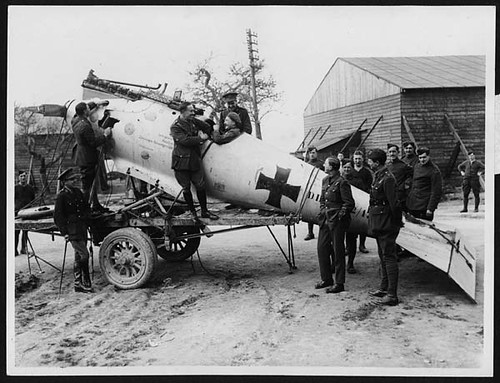
Haig World War 1 Collection on Flickr
The National Library of Scotland have added 2000 photographs to Flickr's public Commons collection. The most interesting photographs are probably the ones from the papers of the papers of Field Marshal Haig, an extraordinary set of photos from the fighting in World War 1.


Sunday, February 28, 2010
Sunday Fail : Chauchat
Some weapons seem great in the workshop or drawing board. However once they are used on the slightly less controlled situation of the battlefield then their design flaws are often shown up especially if they have been badly made. Such was the case with the FM Chauchat or Fusil Mitrailleur Modele 1915, a light machine gun developed by the French in the First World War.
Over a quarter of a million Chauchats (named after the man who headed the commission that accepted the gun into service) were made making it the most widely produced automatic weapon of the war and it was used by the French and seven other nations. It was one of the first light machine guns that could be carried and fired by 2 men, someone to fire it and someone to assist him, instead of needing a whole team. There was just one problem with the Chauchat. It was rubbish.
It's main problem was the open sided magazine. In a muddy environment it caused the gun to easily jam. It was used in the trenches. Enough said. It's bad ergonomics and loose bipod also made it an inaccurate weapon when it wasn't jammed. It also overheated easily if used for long bursts rendering the gun useless until it cooled down. This could take several minutes which obviously was not a good thing if the Boche were attacking.
The 8mm Lebel cartridge it had to use caused some of the problems as the cartridge's taper dictated the semi-circular nature of the magazine. It's action was also not suited for a light machine gun. It's design flaws were made worse by the gun's generally poor standard of manufacture and the poor raw materials used. The gun was quite light though which was maybe it's only virtue.
Improved guns without the open sided magazine were designed but were too late to see any service in the war. The gun itself was immediately replaced with superior guns after the war. Indeed there were superior guns like the Hotchkiss M'le'09 around before the Chauchat that should have been adopted instead. It has been described as the worst machine gun ever which is maybe a little unfair but the gun was certainly bad enough to qualify for this series.

Over a quarter of a million Chauchats (named after the man who headed the commission that accepted the gun into service) were made making it the most widely produced automatic weapon of the war and it was used by the French and seven other nations. It was one of the first light machine guns that could be carried and fired by 2 men, someone to fire it and someone to assist him, instead of needing a whole team. There was just one problem with the Chauchat. It was rubbish.
It's main problem was the open sided magazine. In a muddy environment it caused the gun to easily jam. It was used in the trenches. Enough said. It's bad ergonomics and loose bipod also made it an inaccurate weapon when it wasn't jammed. It also overheated easily if used for long bursts rendering the gun useless until it cooled down. This could take several minutes which obviously was not a good thing if the Boche were attacking.
The 8mm Lebel cartridge it had to use caused some of the problems as the cartridge's taper dictated the semi-circular nature of the magazine. It's action was also not suited for a light machine gun. It's design flaws were made worse by the gun's generally poor standard of manufacture and the poor raw materials used. The gun was quite light though which was maybe it's only virtue.
Improved guns without the open sided magazine were designed but were too late to see any service in the war. The gun itself was immediately replaced with superior guns after the war. Indeed there were superior guns like the Hotchkiss M'le'09 around before the Chauchat that should have been adopted instead. It has been described as the worst machine gun ever which is maybe a little unfair but the gun was certainly bad enough to qualify for this series.

Friday, August 1, 2008
Book Review : The Baby Killers by Thomas Fegan
 Zeppelins fascinate me especially their use in WW1 where, lets face it, they didn't do very well. The Baby Killers documents the use of the zeppelin (which i am using for the Schütte-Lanz airships too) as a bomber in WW1 along with aeroplane bombers which followed on afterwards.
We can only suppose what it must have been like on one of these raids, flying slowly over the seas and then over land in often terrible weather and cold (raids took place at night). Navigation was rudimentary and the zeppelin could not outrun trouble. Although it could out climb aeroplanes and flak at least for a while the crews were always aware they were traveling on a huge slow moving bag of highly inflammable gas. Indeed such was the fear of the gas that in some cases crewmen chose to jump overboard out of the zeppelin (without a parachute and thus to near certain death) if the zeppelin was on fire rather than be burnt alive. Thomas Fegan documents all this as well as including some intriguing photographs from the raids.
The reaction of the British people is also documented, and Fegan reveals that the "stiff upper lip" was not always in evidence. This was the first time war had been raged against civilians on such a scale on the British mainland for centuries and the first time civilians had been bombed from the air and it was a terrible shock. Waging war on civilians was considered cowardly and criminal, the German zeppelin crews were called baby killers (hence the book's title). Fegan quotes from letters and diaries of normal people to convey the shock, fear and sometimes excitement of the people during the raids.
The second part of the book is a gazetteer documenting where each raid took place. Of course i had to look at Birmingham, actually we fared quite well here and got off pretty lightly. However amusingly on one zeppelin raid the zeppelin was sent to bomb Liverpool but went slightly off course and ended up mistaking Tipton for Birkenhead and bombed that instead.
Overall a very readable and enjoyable book which does a good job of portraying the events and also the people behind them.
Subscribe to:
Posts (Atom)